
Storm Damage Roof Repair in Douglasville, GA
Douglasville takes straight-line wind off the ridge most springs, and hail cells track through Douglas County often enough that we know where to look before the ladder goes up. iRoofer Contractors is a family-owned crew based in nearby Dallas, GA since 2019. After a storm we tarp anything open to the weather, map the damage slope by slope, and give you a written scope you and your adjuster can both check. Call (470) 236-1410 or start at https://iroofercontractors.com/contact/.
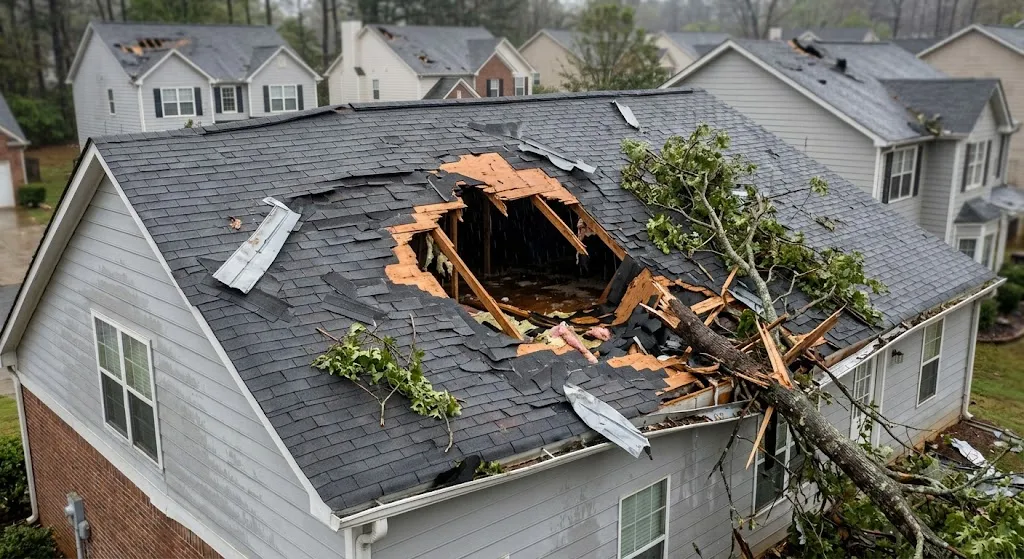
Roof leaking after a Douglasville storm? Start here
If water is coming through a ceiling right now, call (470) 236-1410 before you do anything else and tell us it’s active. Stay off the roof, get people and electronics away from the wet area, and take photos inside and from the yard. Active leaks and roofs opened by wind or limbs go ahead of routine work, and we put on an emergency tarp as soon as the schedule and safe access allow. If we can’t be there today, you’ll get an honest window and tarping guidance. We keep shop hours (Mon–Fri 9–7, Sat 9–5) and don’t advertise 24/7 service.
Straight-line wind leaves a pattern
Unlike hail, which scatters, straight-line wind damage is directional — concentrated on the windward slope, heaviest along the rake and ridge, tapering as you move leeward. That pattern is itself evidence, and it is what distinguishes a genuine wind event from generalised wear when a claim is being assessed. We map the damage by elevation rather than describing the roof as a whole, photograph the creasing and the lifted ridge caps, and note the fascia, gutter and fence damage that corroborates direction and timing across the rest of the property.
Hail damage on Douglasville roofs: what we look for
Hail scatters where wind is directional, so we read it differently. On the shingles we look for bruises: soft spots where granules have been knocked loose and the mat underneath is exposed or fractured. Off the shingles we check the soft metals: box vents, pipe-boot collars, flashing, gutters and downspouts. Dents there are dated evidence that ties the roof damage to a specific storm. We photograph it all by elevation, with a scale reference, because “the roof has hail damage” is a sentence an adjuster can argue with and a slope-by-slope photo set mostly isn’t. More: our Georgia hail damage checklist.
Claim scope, supplements, and building it back properly
Insurers frequently write an initial scope that omits what the code and manufacturer actually require — drip edge, valley membrane, starter course, adequate ventilation. Those omissions are not usually bad faith, they are a desk estimate written without the roof in front of them, and they are correctable with documentation. We supplement rather than silently reducing the build to fit the cheque, because a roof installed outside manufacturer specification does not carry the warranty you think it does. Douglas County handles its own permitting and inspections when structural work is in scope.
More on how we handle the claim side: roof insurance claims help.
Repair or replace after the storm
Plenty of Douglasville storm calls end with a targeted repair: a few creased tabs, a ridge run, a pipe boot, a section of flashing. When the damage covers multiple slopes, or the roof was already near the end of its life, a patchwork repair just moves the next leak somewhere else. We’ll tell you which one you’re looking at and why, in writing. Localized fixes: roof repair in Douglasville. Full tear-off: roof replacement in Douglasville. Gutters and fascia hit by the same storm: gutter repair in Douglasville.
Why a local crew for Douglas County storm work
After a big storm, out-of-area crews show up with yard signs and a deposit form. We’re in Dallas, family-owned since 2019, and the same phone number answers the warranty call years from now. We install Owens Corning shingles as an Owens Corning Contractor Rewards member when that system goes back on the roof. Douglas County runs its own building permit department and inspection line. When structural work is in scope, we pull the permit and schedule the inspections.
Questions Douglasville homeowners ask us
Yes. Roofs open to weather and active leaks go to the front of the line. Call (470) 236-1410 and say water is coming in. We put on an emergency tarp as soon as the schedule and safe access allow, then come back for the permanent repair once it’s dry.
It matters for how the damage is documented. Wind is directional, concentrated on the windward slope, rakes and ridge. Hail is scattered and shows up as bruised shingles plus dents in soft metals. Many Douglasville storms bring both, so we document each separately.
Getting the roof documented first means the adjuster’s visit starts from photos and a scope, not a guess. Your policy sets its own notice requirements, so check it, and don’t wait on mitigation. A tarp protects the house and your claim.
Pattern and corroboration. Straight-line wind damage concentrates on the windward slope and along the rake, and it lines up with damage to gutters, fascia and fencing. We document all of it by elevation.
Usually neither — their desk estimate often omits code-required items like drip edge, valley membrane or ventilation. That gets supplemented with documentation rather than by cutting the build quality.
Yes, as soon as the schedule and safe access allow when a roof is open to weather. Mitigating promptly also protects your claim, since insurers can reduce settlements for damage that worsened afterwards.
Douglas County, which runs its own building permit department and inspection scheduling. Permits apply where structural work is involved; surface repairs generally do not require one.
No. You choose your contractor. A preferred-vendor list is a convenience for the insurer, not an obligation on you.